How to Verify an Overseas Job Offer Before Paying a Recruitment Agency in Kenya
A licensed agency is not proof that a vacancy is real. Here is how to check both.
In this article
Kenya News Agency reported on 15 October that the government had issued a formal warning about fraudulent overseas recruiters, some of them demanding upfront fees for vacancies that do not exist. If you are exploring work abroad, that warning matters, because losing KES 50,000 or more to a scam is not a recoverable mistake for most households.
This guide walks you through every check you should run before you hand over any money or sign anything.
Start with the Official Agency Register
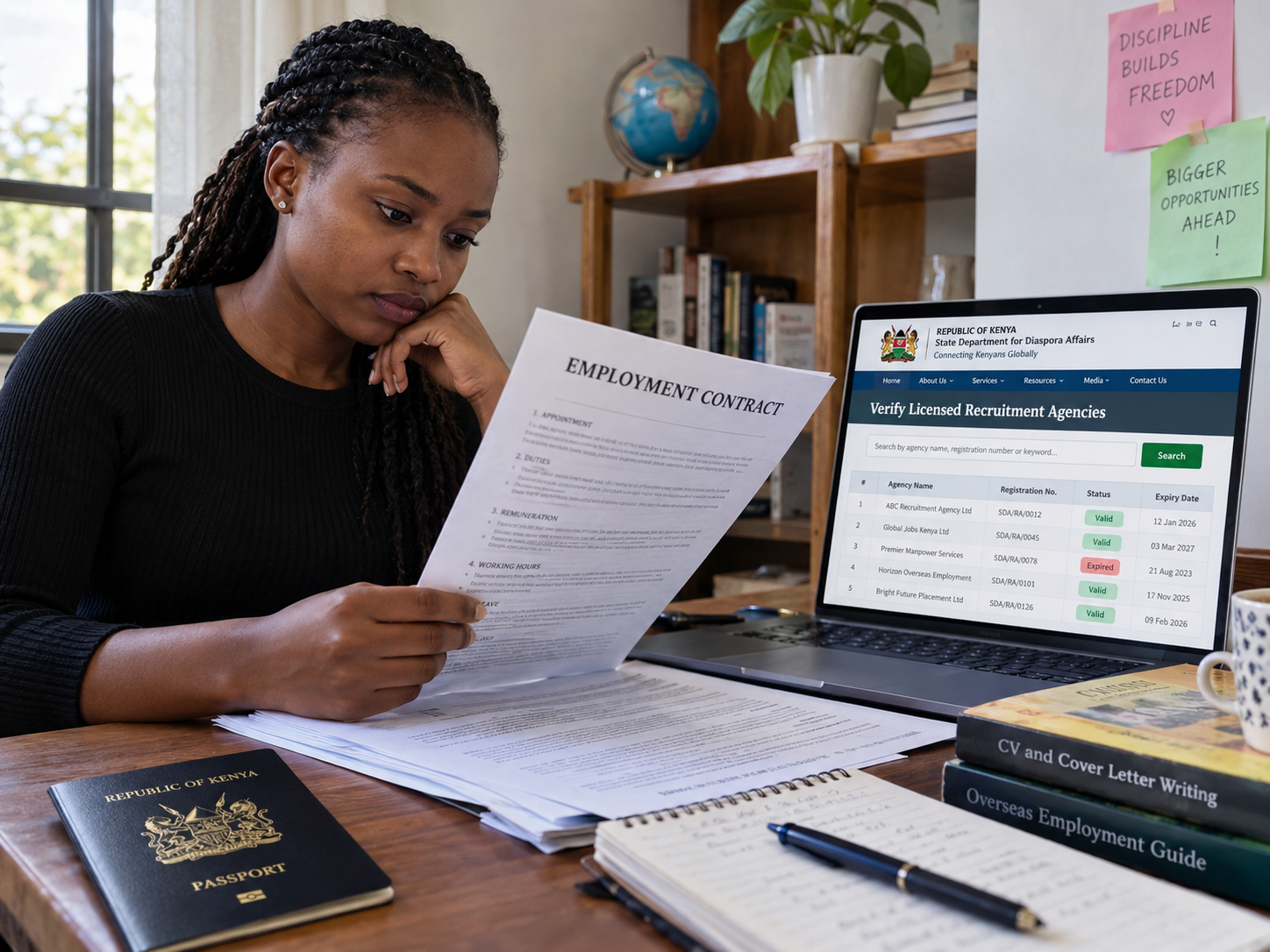
The State Department for Diaspora Affairs maintains a public verification service where you can confirm whether a recruitment agency is registered and licenced to place Kenyans in overseas employment. You can access it at diaspora.go.ke.
Search the agency by name and by registration number. If it does not appear, or if the licence has lapsed, stop there. Do not proceed on the promise that paperwork is "being renewed."
Here is the distinction that matters most: a licenced agency is not, by itself, proof that a particular vacancy or offer is genuine. An agency can be fully registered and still advertise roles that do not exist, or forward your documents to employers who have not authorised them to hire. Licence status is the first check, not the last.
Verify the Employer Independently
Once you have confirmed the agency is licenced, verify the employer on the other end of the offer. This step is where most jobseekers skip and where most fraud succeeds.
Search the company name on the business registry of the destination country. Gulf states, the United Kingdom, and most European countries have free public registers. A legitimate employer will appear.
Look up the company's official website independently. Do not click a link sent to you by the agency. Type the domain yourself and check that it matches what is on the offer letter.
Find the company's publicly listed contact details and call or email the HR department directly to confirm they are hiring through this agency for this role.
Search the employer name alongside words like "scam," "complaint," or "Kenya" and read what comes up.
If the agency resists you making direct contact with the employer, treat that as a serious warning sign.
Read the Contract Before You Sign Anything
A genuine overseas employer will provide a written contract before you travel. Read it carefully, ideally with someone who can help you understand labour law terms. Check for these specifics:
Job title and duties. The role described should match exactly what you were told during recruitment. Vague language like "general duties as required" gives an exploitative employer room to assign you any work.
Salary in the local currency of the destination country. Confirm the amount is above the legal minimum wage for that country and sector.
Working hours and rest days. Many complaints from Kenyans working abroad involve excessive hours and no days off. Both should be stated explicitly.
Accommodation and food. If these are provided, find out whether deductions will be made from your salary to cover them, and how much.
Return ticket and repatriation. Who pays if the contract ends early or you need to come home? This should be written down.
Dispute resolution. Which country's law governs the contract? A contract governed entirely by a foreign jurisdiction can leave you with very little recourse.
If you are given a contract only on arrival, after you have already paid fees and flown out, you are in a vulnerable position. Insist on receiving and approving the contract before any money changes hands.
Understand What Fees Are Legal
Kenyan law caps what a licenced recruitment agency may charge you. As a rule, legitimate agencies recover the bulk of their fees from the employer, not from the worker. If an agency is asking you to pay substantial sums upfront before you have a confirmed, verified job offer, that is a red flag.
Specific things to question immediately:
Fees paid in cash with no official receipt
Requests to pay into a personal M-Pesa number rather than a company account
"Processing fees," "visa reservation fees," or "slot booking fees" before any paperwork has begun
Pressure to pay quickly because "slots are filling up"
Requests to pay more money at each stage, with the job always just one more payment away
Ask for an itemised receipt for every payment. If the agency refuses, walk away.
Confirm Work-Permit Procedures
Every country has its own work-permit process, and a legitimate agency will be transparent about it. Ask directly:
Which type of work permit will you be issued?
Who applies for it, you or the employer?
How long does it take?
What happens to your application if the permit is denied?
Then verify those answers yourself. Most destination-country embassies in Nairobi publish work-permit requirements on their official websites. If what the agency tells you contradicts what the embassy publishes, do not proceed.
Be especially careful about offers that claim you will travel on a tourist or student visa and convert it to a work permit after arrival. In most countries, this is either illegal or unreliable, and it places you in an undocumented status with no employment protections.
Spot the Classic Warning Signs
Fraudulent overseas job offers follow recognisable patterns. The Kenya government's October warning specifically flagged agencies demanding money for nonexistent vacancies. Beyond that, watch for:
An offer that arrived unsolicited via WhatsApp, Facebook, or a personal message
A salary that is dramatically higher than market rate for the role and destination
No physical office address, or an address that does not check out on Google Maps
An agency that cannot produce its registration certificate when you ask
A job offer issued with no interview, or only a brief WhatsApp chat
Urgency and pressure as standard communication tactics
A contract written entirely in a language you do not read
How to Report a Suspicious Offer
If you believe an agency is operating fraudulently, report it. You can contact:
The State Department for Diaspora Affairs through diaspora.go.ke, which oversees overseas recruitment regulation.
The Directorate of Criminal Investigations (DCI) for fraud involving money already paid.
The nearest Huduma Centre if you are unsure where to start.
Reporting matters even if you did not lose money. It can prevent the same scheme from reaching other jobseekers.
A Quick Checklist Before You Pay Anything
Agency appears on the State Department for Diaspora Affairs register with a current licence
Employer verified independently on the destination country's business registry
HR department at the employer confirmed the vacancy and the agency
Full written contract received and understood before any payment
Contract specifies salary, hours, rest days, accommodation terms, and repatriation
Work-permit type confirmed and cross-checked with the destination-country embassy
All payments made to a company account with official receipts
No offer made under time pressure, without an interview, or via personal social-media messages
The process takes a few days of careful checking. That is far less costly than losing your savings, or worse, travelling to a role that does not exist.